
Two topologies, one continuous platform from UHF to W-band
Our components draw on two distinct, dielectric-free volumetric topologies: a coaxial Stepped-Impedance Resonator (SIR) design covering UHF to X-band, and a Locally Resonant Metamaterial design covering X-band to W-band, developed at EPFL’s Laboratory of Wave Engineering (LWE) and Microwave and Antenna Group (MAG).
What makes it different
Quasi-orthogonal tuning
Within each topology, center frequency, bandwidth and filter order can be adjusted largely independently, addressing very different requirements without a full redesign.
Shared physics across components
Filters, diplexers, antennas, phased arrays, leaky-wave antennas and RF front-ends all draw on these two topologies, enabling system-level integration.
Dielectric-free
A fully metallic, volumetric technology avoiding dielectric losses and the material qualification burden they bring to space programs.
Modularity by design
For a given set of requirements, an infinite number of solutions is possible, each trading off differently between dimensions, electrical performance and multipactor threshold.
Manufacturing-ready
Compatible with conventional CNC machining and additive manufacturing, for fast transfer from prototype to industrial production.
Space-qualified
Power handling and multipactor threshold are designed in from inception against ECSS constraints, not retrofitted after the fact.
From simulation to measured hardware
Prototypes have been machined, assembled and measured, with results published or submitted to IEEE venues.
| Component | Band | Details |
|---|---|---|
| L-band coaxial SIR filter | 1.466 – 1.543 GHz | 4th-order short-end four-section, built on two-level, coaxial Stepped-Impedance Resonator filter. |
| X/Ku-band metamaterial filter | X – Ku band | Compact, tunable Locally Resonant Metamaterial filter for high-power applications, with mechanical tunability. |
| Leaky-wave filtenna | Broadband SATCOM | Sub-wavelength, open Locally Resonant Metamaterial waveguide structure combining filtering and radiation in a single part. |
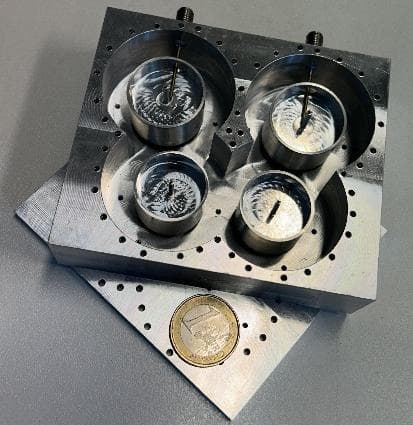
L-band coaxial SIR filter
4th-order L-band coaxial SIR half-wavelength four-section filter (IEEE IMS 2024).
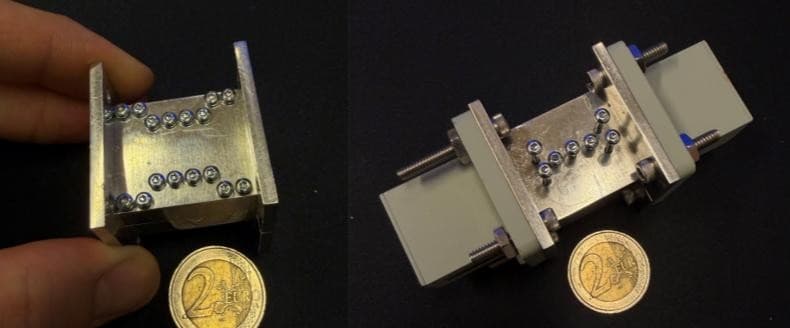
X/Ku-band Locally Resonant Metamaterial filter
Compact and tunable (order, bandwidth and operating frequency) Locally Resonant Metamaterial filter for X/Ku band (IEEE IMFW 2026 paper).
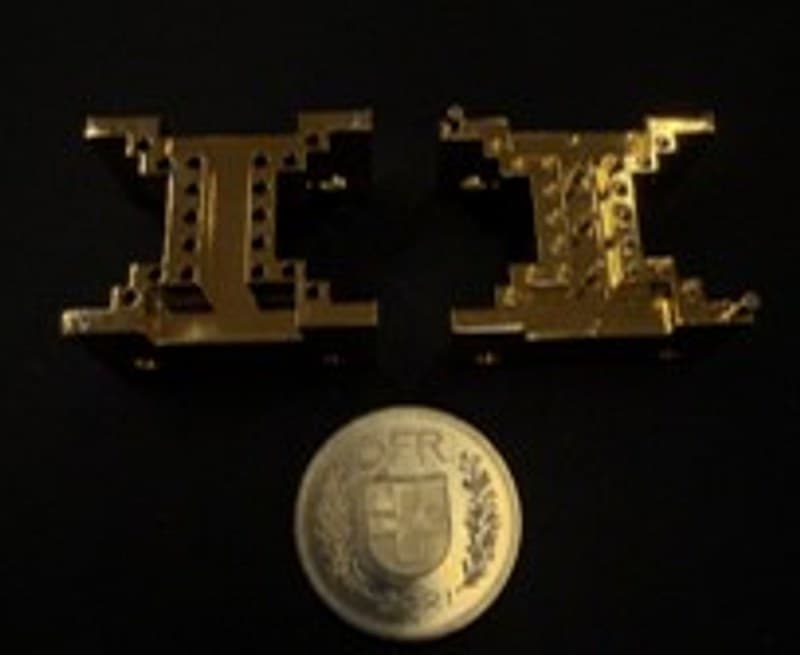
Ku-band Locally Resonant Metamaterial bandpass filter
Narrow Ku-band Locally Resonant Metamaterial bandpass filter, F0 = 12 GHz, 1.25% relative bandwidth (published at IEEE NEMO).
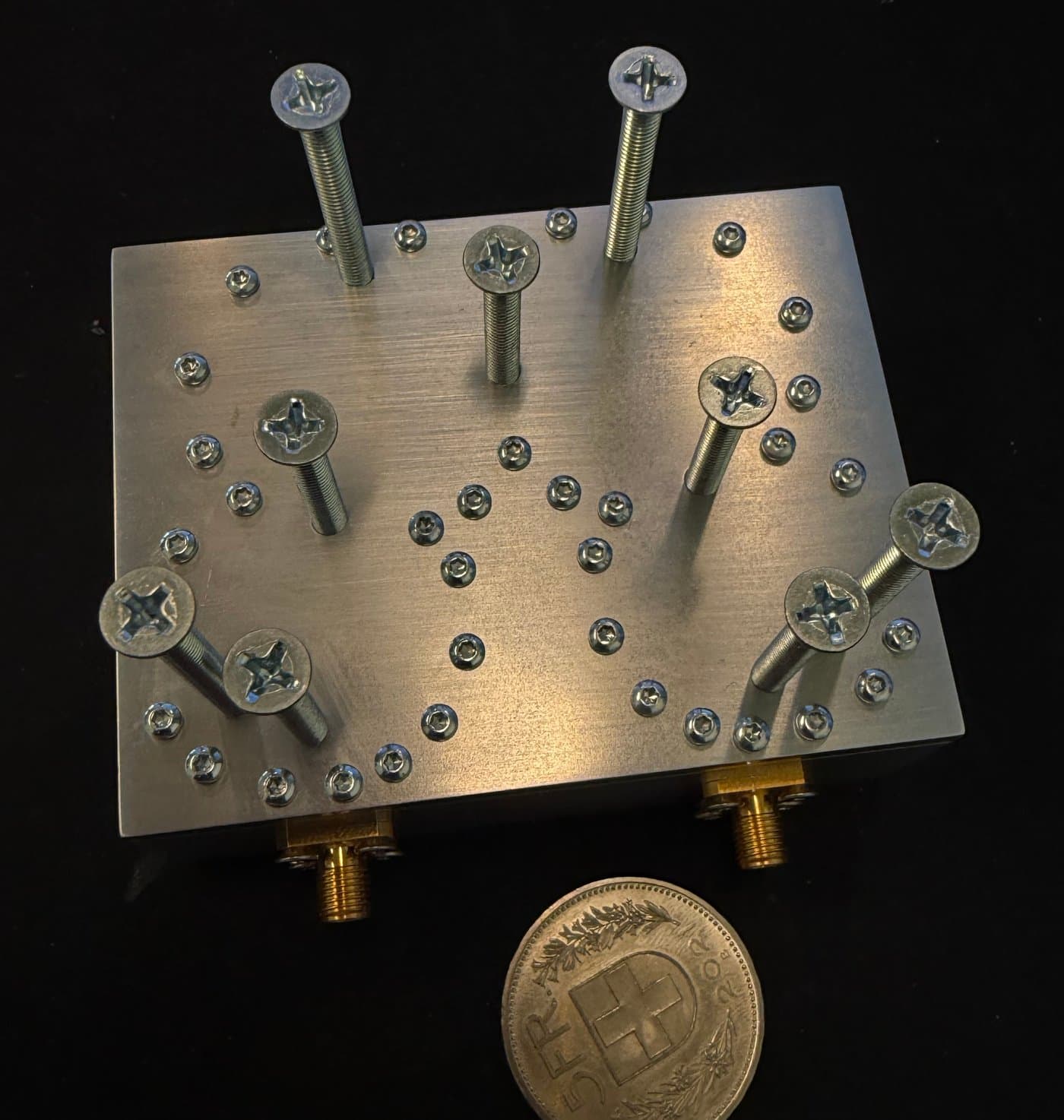
L-band quarter-wavelength coaxial SIR two and three-section filter
L-band filter combining two- and three-section coaxial SIR quarter-wavelength topologies.
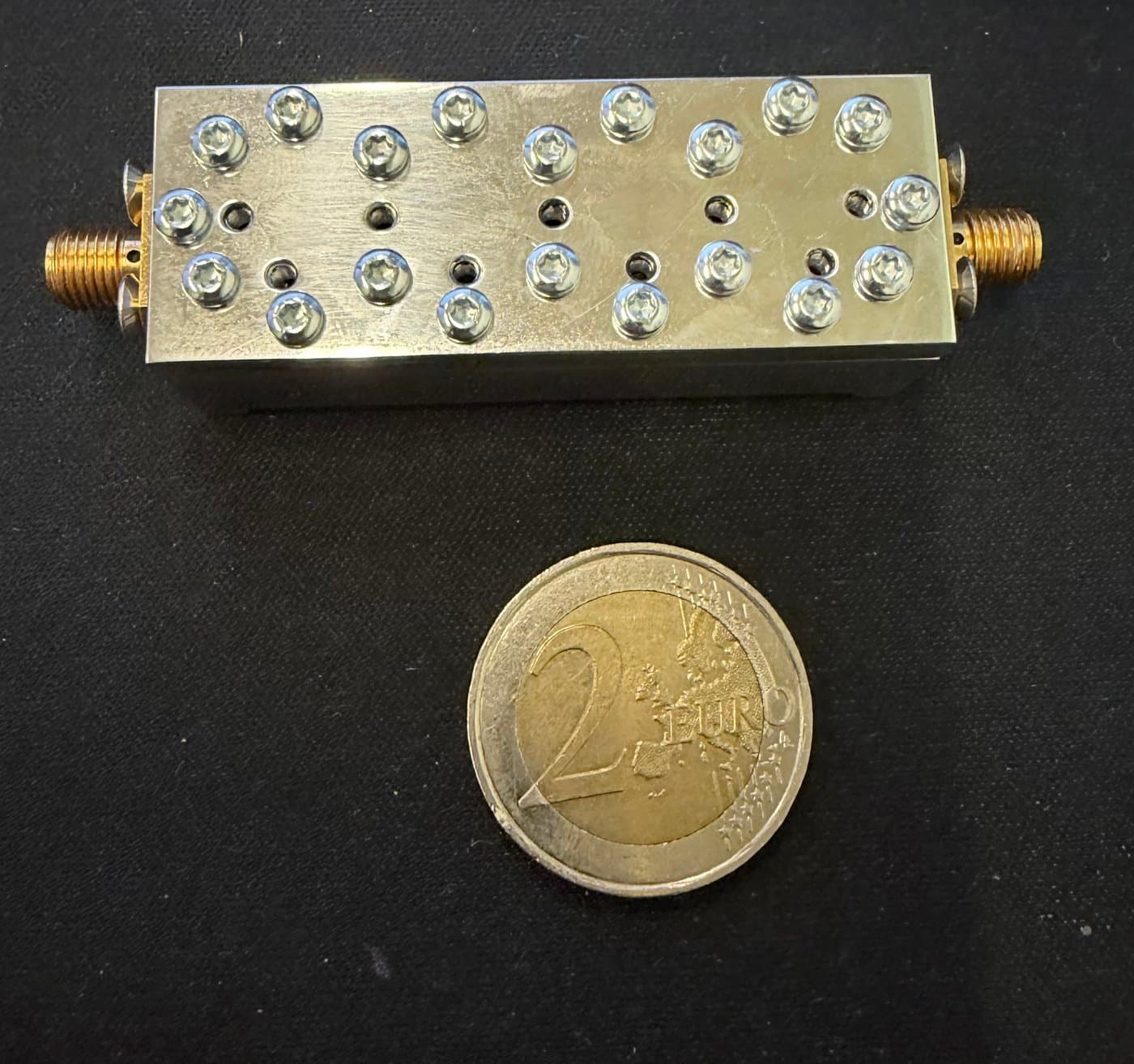
C-band narrowband filter
C-band narrowband filter, F0 = 5.3 GHz, relative bandwidth below 1%.
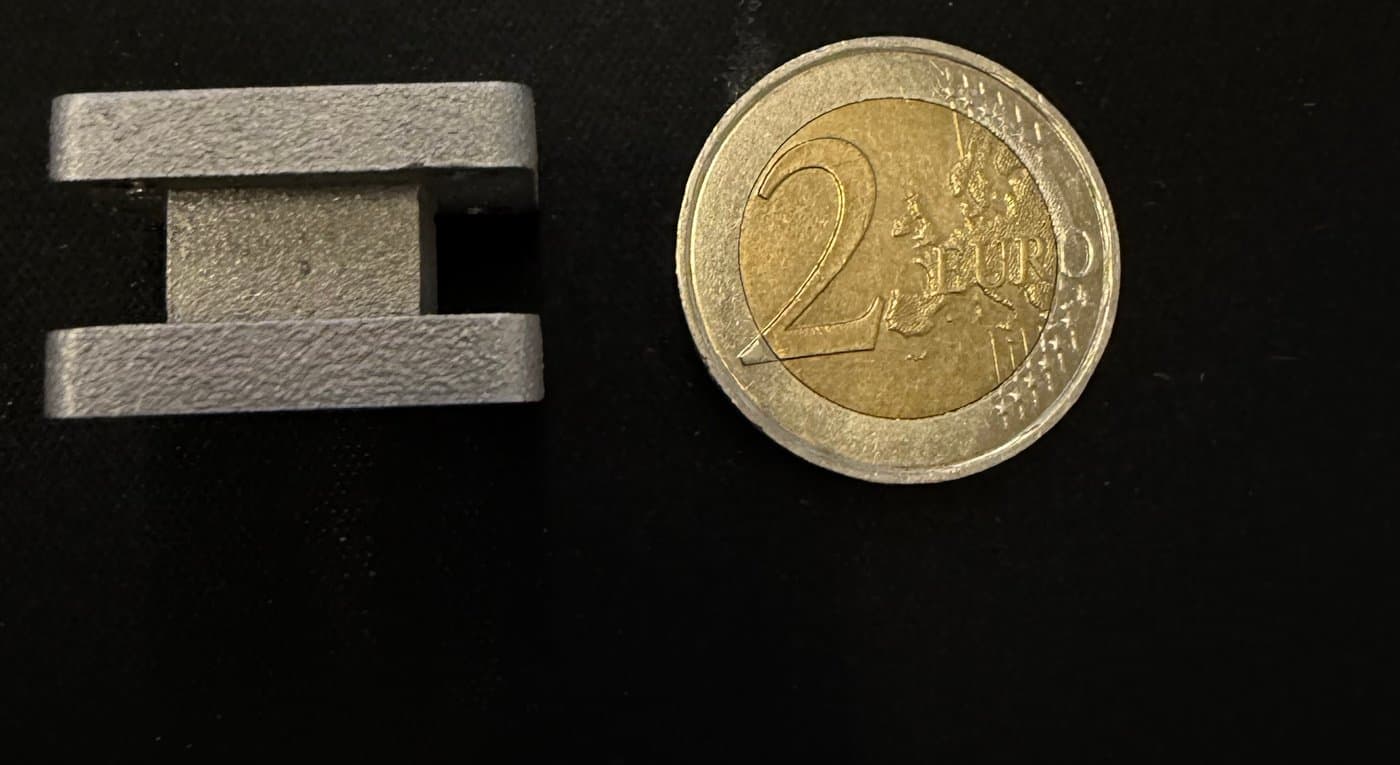
Ka-band Locally Resonant Metamaterial wideband filter
Ka-band wideband filter, 22% relative bandwidth centered at 27.5 GHz.
Built for industrial transfer
Every topology is designed with conventional CNC machining and additive manufacturing in mind, so a validated prototype can move to volume production without re-engineering the part from scratch.
Protected and peer-reviewed
Three PCT patent applications have been filed and are managed with EPFL’s Technology Transfer Office. The underlying research has been recognized with a Best Student Technical Paper Award (IEEE MTT-S NEMO 2026) and is the subject of several IEEE journal submissions. See Company for the full list.